Tuesday, 30 April 2013

Book of the month: Sitting in the hot seat by Rhona Flin

Before I begin this review, I have to confess something: Dr Flin is one of the greats in human factors research and my writing a review of one of her books may seem hubristic. I therefore appeal to you (kind reader) to take all comment in the spirit in which it is meant, as a subjective appraisal by a neophyte of an expert's work.

Flin's book focuses on the individual (pilot, police officer, manager) who leads the on-scene response to an emergency. She also provides an overview of how different services train and assess these individuals. At the same time, Flin makes suggestions on how to improve the preparedness of these individuals. Flin's book was published in 1996, almost twenty years ago, and although aviation had been making strides with Cockpit (later Crew) Resource Management (CRM), the lessons from the flightdeck had only been taken up by other professionals in a haphazard manner. 

Flin's first chapter starts with a quote from the Cullen report into the Piper Alpha disaster in which 167 people died:
"The failure of the OIMs [offshore installation managers] to cope with the problems they faced on the night of the disaster clearly demonstrates that conventional selection and training of OIMs is no guarantee of ability to cope if the man himself is not able in the end to take critical decisions and lead those under his command in a time of extreme stress."
It is possible that only a few men died in the initial explosion; the majority of the remaining crew followed standard procedures and gathered in the accommodation block to await further instructions from the OIM, which never came.

Later on in chapter one, Flin provides further quotes from the Cullen report which give us insight into the actions of the OIM:
"The OIM had been gone 'a matter of seconds when he came running back' in what appeared... to be a state of panic..."
"One survivor said that at one stage people were shouting at the OIM and asking what was going on and what procedure to follow. He did not know whether the OIM was in shock or not but he did not seem able to come up with any answer."
The Cullen report led to a focus on safety management systems and on the process of OIM training and selection. The report called for regular training of OIMs in emergency exercises which would allow them to practice decision-making in a stressful environment.

The parallels with my own job as an anaesthetic consultant are clear: 99% of my work is straightforward and routine, 1% of the work is crisis management requiring rapid action to prevent patient harm or death. In 1990 Cullen realised that the only way to make sure that the OIMs were prepared for the 1% was to practice and simulate. Although we have made a start in healthcare and in many respects Anaesthesia is ahead of the game, we still today do not practice for rare events frequently enough.

In the remainder of chapter 1, Flin supplies definitions and provides an overview of the incident command and control procedures in the emergency services, hazardous industries (nuclear, chemical, etc.) and the armed forces. She then goes on to look at the lack of training which contributed to other major disasters such as the Scandinavian Star fire, the Bradford fire, Heysel Stadium, Hillsborough Stadium and others.

Fig 1
Chapter 2 explores selection of incident commanders and Chapter 3 describes (in some detail) the training of incident commanders in different workplaces. Chapter 4 looks at the stress of incident command which I discuss a bit later in this post. Chapter 5 explores command decision making, which deserves a whole post for itself (stay tuned). Chapter 6 looks at incident command teams (including high performance "dream teams") and has an excellent diagram of a model of command team performance (Fig 1). Flin mentions the need for a shared mental model, a term I often use in debriefing but importantly contrasts this with "groupthink", where a team clings on to the wrong mental model. Flin also discusses whether everybody needs to know "the big picture" and this is certainly something that is of interest in the operating theatre. As people arrive intermittently to help out with a critical incident who should update them and does every new team member need to know the whole story? Chapter 7 is entitled "Conclusions and future directions". Here Flin concludes that the best leaders can diagnose a situation, have a range of leadership styles that they can adopt and then match the correct style to the situation.


Fig 2
One critique I have of the book is the perhaps unnecessary complexity of some of the diagrams (Fig 2 shows us, amongst other things, the location of the VGA to composite video encoder in a control room) and the over-description of some of the training installations such as: "This has a central control room, a tactical and action room, which can accommodate 24 observers as well as the rescue leader, and three smaller team rooms." (p.78) Flin also provides a lot of information on individual courses which, although interesting, can at times become overly descriptive.


I think the main lesson I derived from Flin's book concerns the role of stress on incident commanders. In the Piper Alpha explosion mentioned at the beginning of this post, the OIM is in a state of panic, people are shouting at him and he's not responding. The Hillsborough chief superintendent "froze" (p.30). One of the two vital attributes of a leader according to World War II Field Marshall Montgomery is "calmness in crisis" (p.40)  Flin refers to a competence assessment of OIM (p.55) which includes an ability to "Deal with stress in self and others". The best chapter in the book is devoted to "The Stress of Incident Command". However, when I look around today at the various rating tools and marking systems there is neither a mention of "coping with stress" nor is there an approach to exploring stress under pressure during simulation or in "real life". It may be that, as with "communication", it is thought that the ability to cope with stress underlies all the other behaviours that we do assess and talk about (e.g. planning, situational awareness, leadership). Having been involved in a few critical incidents I can easily recall the effect of stress on some of the individuals in the team, to the extent that this was the main driver in terms of loss of communication and prioritisation. I would therefore like to see more of a focus on stress in simulation and the exploration by simulation faculty of ways of dealing with stress by candidates. Flin mentions taking a deep breath as one example. 

To steal another quote that Flin has attributed to Montgomery: "One great problem in peace is to select as leaders men whose brains will remain clear when intensely frightened; the yardstick of 'fear' is absent." It is here where simulation can make a difference; the stressful nature of high-fidelity simulation allows us to assess our candidates' responses and behaviour. Much more importantly, it allows us to coach our candidates and promote self-reflection so that they might improve these same responses and behaviour when disaster threatens in the "real world". Flin provides a quote from Charlton (1992):
"Knowledge of the effects of stress enables the individual to take positive steps to avoid the stressors or to reduce them to limit their impact, thereby defusing a potentially dangerous situation."

However, as I mentioned above, simulation is still under-utilised within healthcare. Let's change that.

Thursday, 18 April 2013

Experts and their unknown knowns

On the 12th February 2002, Donald Rumsfeld uttered his most memorable words as US Secretary of Defence:
"Reports that say that something hasn't happened are always interesting to me, because, as we know, there are known knowns; there are things we know that we know. There are known unknowns. That is to say, there are things that we now know we don't know. But there are also unknown unknowns. There are things we do not know we don't know" (1)
Wikipedia has a nice article on this statement, including the missing pair: unknown knowns. Rumsfeld does not mention it, perhaps because there is some confusion about what an "unknown known" is. The Wikipedia article calls it "the most dangerous type of unknown" but then (at the time of writing and with an understanding that Wikipedia is constantly edited) goes on to make a bit of a hash trying to explain it. There is a suggestion that an "unknown known" is the claim that weapons of mass destruction existed in Iraq, or the Abu Ghraib scandal or things we refuse to acknowledge that we know.

Personally I prefer to think of "unknown knowns" as things we didn't know we knew. This is what Dörner, in his book Logic of Failure, is talking about when he says he knew a doctor who could diagnose a disease with great certainty but this doctor didn't know how he did it. Dörner explains it as a type of intuition and goes on to comment that experts often display this type of intuition. This integrates very nicely with a 4-stage framework (first developed by Noel Burch) for looking at expertise:
  1. Unconsciously incompetent: unknown unknown (The total beginner who has no idea what he doesn't know and is oblivious to the breadth and depth of possible knowledge. This is a dangerous place to be and a scary person to be looking after you in an emergency) 
  2. Consciously incompetent: known unknown (The novice who has become aware of how little he/she knows. A somewhat less dangerous place to be and now, instead of having a scary person looking after you, you have a scared person looking after you.)
  3. Consciously competent: known known (The journeyman who knows a lot but has to spend a lot of time thinking about what he/she is going to do.)
  4. Unconsciously competent: unknown known (The expert who has a sixth sense about things which are about to go wrong or can stop a situation from escalating without telling you how they knew what to do.)
In many ways then the extremes of the framework are the most untroubled places to be; at one end ignorance is bliss and at the other end ignorance is due to the achievement of expertise.

This 4-stage competence framework allows us to see how a learner may progress and implies that moving through the 4 stages is beneficial without drawbacks. However, later on in his book Dörner goes on to explain how more information (loss of the unknown) may be detrimental:
"Anyone who has a lot of information, thinks a lot, and by thinking increases his understanding of a situation will have not less but more trouble coming to a clear decision... We realize how much we still don't know, and we feel a strong desire to learn more. And so we gather more information only to become more acutely aware of how little we know..."(p. 99)

In terms of how the framework relates to simulation-based education, I would like to think that it can help us understand at which stage a participant is. This knowledge should allow the course faculty to tailor the course to the participant. I would also like to think that simulation lends itself well to the little-known 5th stage of competence:
  1. Consciously aware of unconscious competence: known unknown known (An ability to reflect on and examine the behaviours and actions one is carrying out as an expert.)
The Elaine Bromiley case involved a number of experts in anaesthesia and ENT surgery who failed to do the right thing. Partly due to an underdeveloped final stage of competence, these experts were not able to reflect in situ  and realise what the correct sequence of actions should be. Simulation with debriefing allows experts to watch how they make mistakes and learn to develop mechanisms for preventing them. Unfortunately it is experts (consultants) who we see least often in the simulation suite as participants and this needs to change.


Wednesday, 13 March 2013

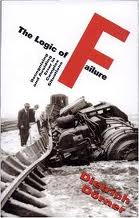
Book of the month: The Logic of Failure by Dietrich Dörner

Let's go and blame somebody for this...
In Dietrich Dörner's book, translated from the German "Logik des Misslingens", he starts off by showing us how complex systems are difficult to manage, using computer simulations of an African tribe and an English town as examples. Dörner then goes on to describe why some systems are complicated (due to complexity, internal dynamics, intransparency and incorrect or incomplete understanding). The book then veers a bit off from a logical trajectory to discuss: Setting goals, Information and models, Time sequences and Planning. He finishes off with a chapter entitled "So Now What Do We Do?". (If you just want to find out "How not to fail" then skip to the bottom of this post)

Good things about this book include the discussion about the Chernobyl disaster and its appreciation that this was an expert team who were not "stupid" people making mistakes. Dörner also made me realise that there are positive goals (this is something I want to make happen) and negative goals (this is something I want not to happen). In general, positive goals are better because they make planning easier. Dörner also suggests ways of dealing with multiple problems including: finding the central problem(s), finding the most urgent/important problem(s) and delegating problem(s).

He also clarified the concept of "repair service" behaviour for me. This is when we don't spend the time to find the central or most important/urgent problems and instead go out to find a problem, any problem. We solve this problem and then go on to find the next problem. "Repair service" behaviour may be better than doing nothing, but it means that the most important problems are overlooked.

An indicator variable in a cage
Dörner helped me with another couple of definitions: critical variables (which influence many other things in a system) and indicator variables (which are influenced by many variables but do not affect much themselves). In a coal mine a critical variable may be the compressive strength of the tunnel supports, while an indicator variable would be the canary.

Dörner also uses the concept of "ballistic decisions". These are "fire and forget" decisions which follow a given trajectory with an unchanging course. The alternative are "rocket decisions" whose trajectory is followed and altered as new information is gathered. Bad planners make a lot of ballistic decisions which they never follow up on to see if they were the correct ones.

In his final chapter "So Now What Do We Do?", Dörner explains the causes of mistakes:

  1. Slowness of thinking (not because we are dim-witted but because we are human)
  2. Only able to process a small amount of information at a time
  3. Tendency to protect our sense of competence
  4. Limited capacity of our memory
  5. Tendency to focus only on immediately pressing problems


A couple of things that could be improved: On p.20 Dörner has a graph showing a good and a bad participant in the English town computer simulation. The starting points for the two participants are the same, but their starting satisfaction scores are different. It is unclear whether this is just a printing error or due to some other cause. Additionally, a graph on p.126 refers to a "heavy black line"which is not to be found.
Dörner also spends 9 pages exploring the HIV epidemic and the statistics surrounding it, which is not really what we need in a book on failure

This book is let down a bit by Dörner's conclusion "There is only one thing that does in fact matter, and that is the development of our common sense." It may be that this phrase has not translated well, but there are enough books and articles out there to show us that "common sense" is very frequently non-sensical. I would have liked to have seen this better explained and perhaps a different choice of words used.

Overall, a very good introduction to some of the theory behind complicated systems with some good tips on how to stop ourselves from being overwhelmed in a complicated system.


According to Dörner the following mark out good participants:
1) They make more decisions and more decisions per goal
2) They act "more complexly" (i.e. they appreciate that a complex system exists and therefore their actions need to be complex)
3) They generate hypotheses (bad participants generate truths) and admit ignorance
4) They ask "Why?"
5) They don't become distracted too easily but also don't become obsessed with something
6) They think ahead
7) They break complex problems or goals into intermediate problems or goals
8) They get the level of detail right, not too rough but not too fine
9) They plan. Planning is good, too much planning is bad and sometimes you've just got get stuck in (he refers to Napoleon's "We engage (the enemy) and then we see" and talks about the military strategist Moltke but doesn't mention one of his best quotes "No battle plan survives contact with the enemy")
10) They reflect on their own thinking and decisions.

Tuesday, 26 February 2013

Inattentional blindness or "What's that gorilla doing there?"

There has been much media attention recently on the fact that radiologists are unable to spot gorillas. For most people, the first encounter with this gorilla will have been the "passing the ball" video which demonstrates a study by Daniel Simons and Christopher Chabris in 1999 at Harvard University. This video shows the limits of human attention.

All of us will have experienced inattentional blindness in our everyday lives, perhaps while driving a car or watching TV. Things which are occurring within our field of vision (and therefore are being picked up by the retina) are being ignored in preference to something else.

What does the study about radiologists add to our understanding about this phenomenon? 83% of radiologists failed to detect an image of a dancing gorilla on a CT scan when they were asked to look for nodules. 100% of untrained observers failed to spot the gorilla. The authors admit that if the radiologists had been told to look for something unusual then they would probably have spotted more gorillas. What the study doesn't tell us is the difference between those radiologists who did or did not spot the gorillas. Did those who spotted the gorillas spot fewer lung nodules because they were less focused on their primary task?

In terms of clinical practice and understanding of human factors, the study adds to the evidence that if you are focused on one task you cannot also focus on something else. This would suggest that a team leader does not get involved in a task. It also suggests that one should be precise when asking someone else to perform a task. For example if you ask someone to keep an eye on a patient's saturations then don't be surprised if they fail to pick up the ectopics on the ECG... you didn't ask them to look at the ECG trace.

Inattentional blindness is a side-effect of our amazing ability to focus on something and stay focused on it. The best defences against are to be aware of its existence and to have another background mental process running which is asking you whether there is something else you are missing while you are focusing on a given task.